Archetyps of Birth
Week One Objectives
Describe the purpose of archetypes as a lens for understanding the inner experience of parents.
Recognize the qualities, needs, gifts, and shadows of the Innocent, Magical, and Wounded Child archetypes.
Use archetypal listening to explore what may be underneath a parent’s words, behaviors, fears, and beliefs without labeling or pathologizing.
Practice responding to Child archetype energy in ways that validate the parent while supporting greater awareness, agency, and capacity.
A Menu of Birth Art Assignments
You can save the document to your device by going to File > download.
Why Use Archetypes in Birth Work?
Learning to recognize archetypal patterns can change the way we listen.
Instead of asking:
“How do I get this person to understand?”
we might ask:
“What is this person experiencing right now?”
Instead of trying to correct fear, we can become curious about what the fear is protecting.
Instead of rescuing someone who feels powerless, we can look for where agency might be possible.
Instead of judging a parent - or ourselves - we can ask:
“What is underneath the judgment?”
Using archetypes can help mentors:
Notice patterns in words, behaviors, and responses.
Listen beneath someone's words to what may be needed.
Understand protective strategies rather than judging them.
Recognize unmet needs and sources of fear or longing.
Reduce judgment toward parents and ourselves.
Expand possibilities by helping parents access additional choices and resources.
Meet parents where they are rather than trying to move them somewhere else.
What Are Archetypes?
Archetypes offer birth workers a powerful lens for understanding what may be underneath a parent’s words, choices, fears, expectations, and behaviors.
They help us recognize familiar patterns of thought, feeling, behavior, belief, energy, and response, especially the patterns that emerge when we feel uncertain, vulnerable, powerful, powerless, hopeful, afraid, or deeply changed.
Instead of asking:
“Why is this person being so difficult?”
the archetypal lens invites us to ask:
“Who is showing up right now, and what might they need?”
Archetypes Are Not Labels
This course is not about putting people into boxes.
An archetype is not a personality type, diagnosis, or fixed identity. It is also not a label that we should announce to a client.
We all carry many archetypal energies within us, and we can move between them depending on what is happening in our lives. The same person who feels confident and capable in one moment may feel frightened, powerless, or in need of reassurance in another.
Archetypes are not “good” or “bad.” Each carries gifts, needs, and protective strategies. The goal is not to get rid of certain archetypes or “graduate” parents into others. Instead, we learn to recognize what each archetype may be trying to accomplish while helping parents access a wider range of internal resources and choices.
Archetypes are not:
Personality types — They don't define who someone is.
Diagnoses — They don't tell us what is clinically happening.
Fixed identities — We can move in and out of different archetypal patterns.
Labels for parents — We use archetypes to deepen our understanding, not categorize people.
Something we announce to a client — The framework is a tool for our own listening and reflection.
Keep Going!
A Different Way of Seeing
This is an experiential course.
You won't simply learn about archetypes. You'll have opportunities to notice them in stories, conversations, case studies, your work with parents, and your own life. You may recognize yourself in some of them. You may feel resistance to others. You may discover that an archetype you once judged has something important to teach you.
There is no archetype you need to get rid of.
The invitation is to:
Notice.
Become curious.
Listen beneath the surface.
Expand the possibilities.
As you move through the course, keep one question close:
Who is showing up right now, and what might they need?
Not:
What is wrong with this person?
Not:
How do I fix this?
Not:
Which archetype are they?
But:
Who is showing up right now, and how can I meet them there?
Our work is not to determine someone's journey for them. It is to meet them where they are, listen deeply, and create enough space for something new to become possible.
The archetypal journey is ultimately not about becoming someone else, but about becoming more fully ourselves.
Journal Prompts
Child and Adult Archetypes
One important distinction we will explore in this course is the difference between Child and Adult archetypal energy.
Any archetypes can emerge in all of us. When we are experiencing uncertainty, vulnerability, fear, overwhelm, or significant change, we often begin by responding from a younger, more familiar place. At other times, we have access to greater perspective, flexibility, and choice.
Neither is wrong: “child” does not mean bad, immature, or incapable, and adult does not mean better or superior. Both are within the range of reasonable human responses.
Child Archetypal Energy
Child archetypes often rely on familiar or protective strategies when we feel uncertain, vulnerable, or overwhelmed. They may seek:
Safety · Certainty · Protection · Approval · Rescue · Hope · Imagination
The Child may look outside of themselves for reassurance or protection. They may want someone to tell them what will happen, make a decision for them, or promise that everything will be okay.
These strategies developed for good reasons, helping us feel safe or cared for at other times. But when circumstances become more complex, those same strategies can sometimes become limiting.
The Child asks:
“Am I safe?”
“Am I loved?”
“Will someone take care of me?”
“Is someone out to hurt me?”
“Will everything be okay?”
Adult Archetypal Energy
Adult archetypal energy offers greater access to:
Discernment · Agency · Flexibility · Resourcefulness · Choice · Integration · Responsibility
The Adult can pause and assess what is actually happening. Rather than reacting automatically, there is greater capacity to consider possibilities, make choices, tolerate uncertainty, and respond to complexity.
This does not mean the Adult always knows what to do.
Being in Adult energy does not mean feeling confident or having all the answers. It means having greater access to the internal and external resources needed to navigate what is happening.
Child vs. Adult
An Invitation to Notice
Think about a time when you were under stress and suddenly felt much younger than your chronological age.
What did you want?
What did you believe?
How did you behave?
Now think of a time when you were able to pause, assess what was actually happening, and respond rather than react.
What was different?
What resources did you have access to?
What allowed you to respond differently?
Our goal is not to eliminate Child energy or remain in Adult energy all the time. Moving between these ways of being is part of being human.
The goal is integration.
We want to be able to recognize what the Child is telling us while also inviting access to the discernment and resources of the Adult.
The Mentor's Role
As birth workers, we will encounter Child archetypal energy frequently.
A parent may ask:
“Can you promise me everything will be okay?”
Or:
“Just tell me what I need to do.”
Or:
“I can't do this. Someone needs to tell me what to do.”
Our instinct may be to reassure, fix, explain, or take over.
But the mentor's job isn't to convince the Child that everything will be okay.
Our job is to help the parent feel seen, supported, and increasingly resourced.
Rather than promising certainty, we can offer connection. Rather than taking away choice, we can help a parent discover where choice still exists. Rather than rescuing, we can help them identify resources and support.
The movement is not:
Child → Adult
as though one is good and the other is bad.
Instead, it is:
Awareness → Integration → Greater Choice
How is this different from art therapy?
The Birthing from Within Birth Art Process is a creative, experiential tool designed to support personal insight and emotional exploration during the perinatal period. Its purpose is to help participants move beyond thinking and planning into sensing and feeling, clarify inner questions, and integrate practical information with personal growth through self-discovery. This process is non-clinical and does not involve psychological assessment, interpretation, or diagnosis.
In contrast, art therapy is a clinical mental health discipline in which a licensed art therapist works with a client to use art-making for the purpose of diagnosis, analysis, and treatment of mental health conditions such as anxiety, depression, trauma, addiction, or emotional distress. Art therapists have advanced graduate-level training in psychotherapy, psychological theory, and art-based assessment, and they work within a regulated scope of practice.
Unlike art therapy, the Birth Art Process does not involve interpreting or analyzing the art or the artist. Instead, it offers a safe, supportive space where individuals can explore their inner world through creative expression, guided by a childbirth mentor or facilitator—not a clinician. It is important to understand this distinction, both to preserve the integrity of the Birth Art Process and to ensure that participants seeking clinical support are directed to appropriate licensed professionals.
Although the title of this course is “Birth Art,” many of these prompts can be adapted for use in working with postpartum clients too. Some of the prompts may need to be adjusted slightly to be relevant for that audience. Keep in mind that newly postpartum parents may have less time and energy to do this kind of inner work and reflection in the weeks following the birth; they may have more emotional and practical space later in the postpartum period.
Some suggestions:
Postpartum in Your Culture (from Birth in Your Culture)
Door to Postpartum (from Door to Birth)
Journey through the Landscape of Postpartum (from Journey through the Landscape of Labor)
Seeing Myself as a Parent
What else can you imagine using?
You can also get creative and make your own prompts, but be sure to check out the info in lesson two about flawed birth art assignments.
Week One Homework: Making and Journaling About Your Birth Art
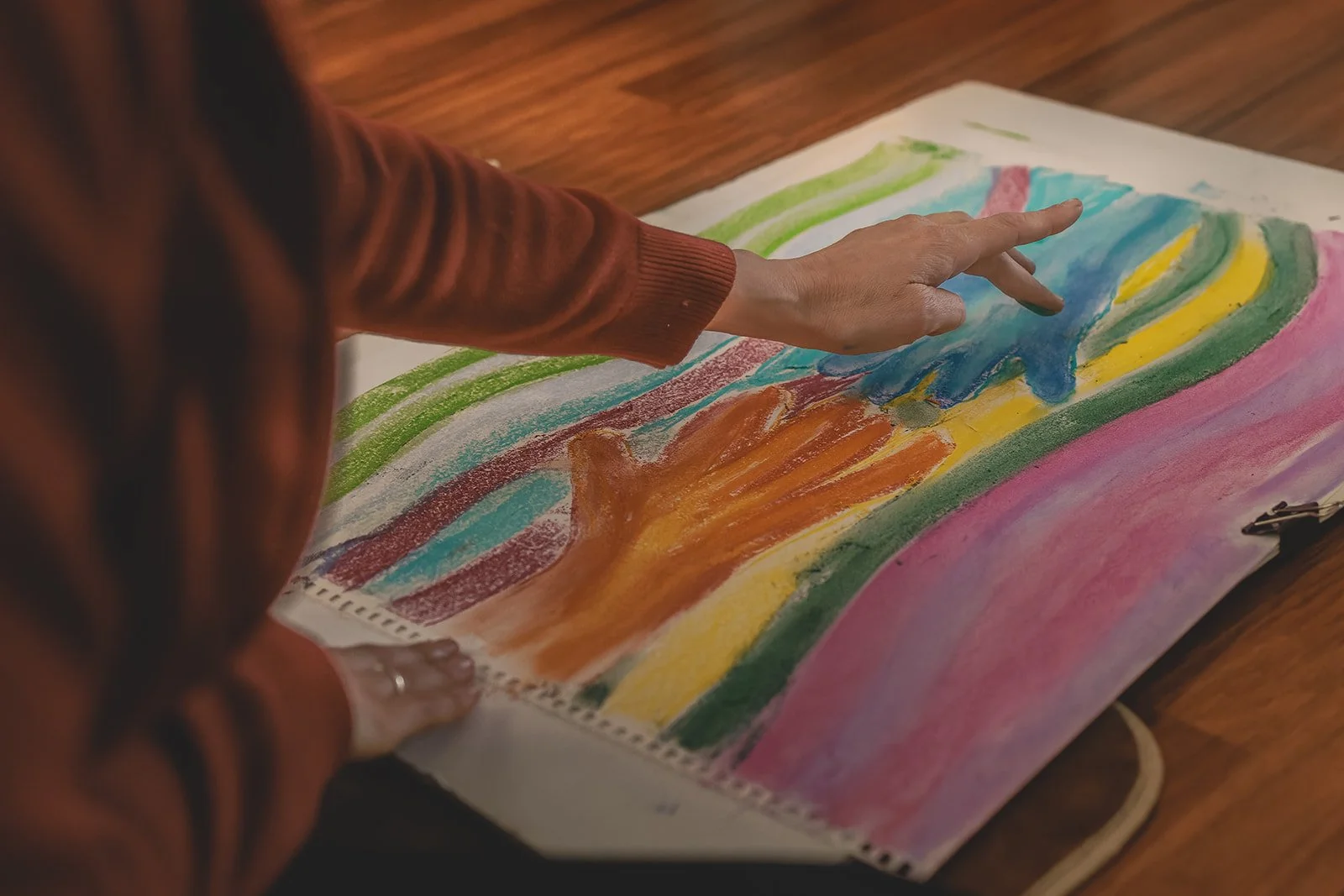
This week draw each of these birth art assignments using chalk pastels:
· Birth in Your Culture
· Landscape of Labor
· Womb with a View
After each drawing, use the prompts to journal about what you discovered about yourself. Using the prompts will deter you from the impulse to describe the image itself. Submit the journaling notes you made following two of your birth art drawings. If you like, you can upload/paste digital images of your drawings along with your homework.
Choose at least two of the following questions (you don't have to answers all of them):
What surprised you? (Either as you made the drawing, or now as you look at it/think about it.)
What didn’t make sense or was confusing, but you drew it anyway?
When looking at the drawing, what do you see now that you didn't see at first?
What do you know now, that you didn’t know before making the drawing?
Is there anything you might do differently now, as a result of making and thinking about your drawing?
As a result of making this drawing, do you have any new questions about yourself, about birth, etc.?
What do you do when you don't know what to do next?
Go to our Community Group to post your homework at least 24 hours before the first live call.